
Golf lessons used to be tied to daylight, driving ranges, and the long patience required to repeat the same motion while hoping the body would slowly remember it. That model still works, and it will never disappear, but something important has changed. A growing share of amateur players now learn in front of screens, launch monitors, projected fairways, and data dashboards that show exactly what the club and ball are doing. TGL did not invent simulator golf, yet it helped push the format into the center of public attention by turning tech-driven golf into a mainstream spectacle. TGL’s official format is built around players hitting real shots into a massive screen and then moving to a technology-enabled short-game area, which made many casual golfers see simulator golf as something serious rather than a niche winter substitute.
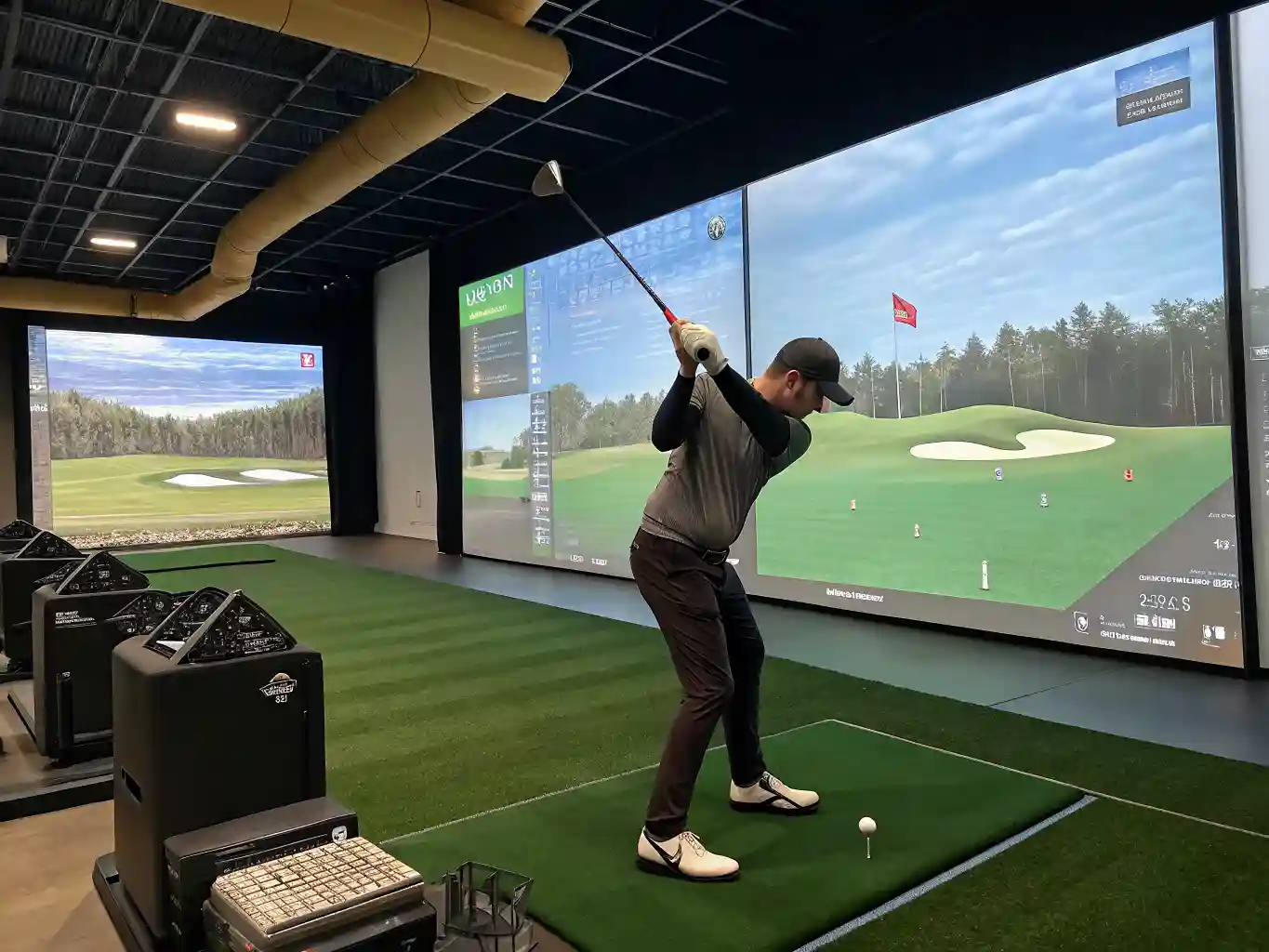
That shift matters because amateurs do not watch professional golf only for entertainment. They also copy habits, training ideas, and environments. When people see elite players perform indoors with immediate feedback, they start asking a simple question: if professionals trust technology to sharpen decision-making and control, why should regular golfers wait for perfect weather and a free tee time to improve? The answer for many is that they should not. Simulators have become a modern classroom for golf, and for a large part of the amateur market, they are becoming the most practical classroom of all.
For years, simulator golf had an image problem. Many players treated it as a novelty, a winter activity, or a backup plan for rainy weeks. Serious improvement was still associated with grass ranges, outdoor ball flight, and in-person coaching. TGL helped crack that perception by showing a format where technology was not hiding from the real game but amplifying it. The league presented indoor golf as fast, visual, strategic, and credible, with real players, real pressure, and real shotmaking. Official TGL materials describe a competition built inside the SoFi Center around advanced simulation, live team matches, and a dynamic playing environment, while reporting on the format has highlighted real turf surfaces, a giant screen, and a reshaped tech-enabled green.
That matters psychologically. Amateur golfers are deeply influenced by what looks legitimate. Many do not need a tour player’s swing, but they do want to feel that the tools they use belong to modern golf rather than a side corner of the sport. TGL gave simulator environments a new visual language: cleaner, sharper, more competitive, less gimmicky. It made indoor golf look like golf’s future-facing wing instead of its compromise option.
There is another reason the league changed attitudes. It simplified the story of technology for everyday players. Most amateurs do not care about every technical layer inside tracking systems, spin algorithms, and surface calibration. They care whether the system can help them hit the ball better, understand their misses, and use time more efficiently. When a high-profile league places technology at the center of the experience, the message becomes easy to grasp. You do not need to master the machine. You need to use the feedback.
That is why simulator lessons now feel more attractive to beginners, busy professionals, and even mid-handicap golfers who once preferred old-school practice. The simulator is no longer sold as a substitute for golf. It is sold as a smart way to learn it.
One of the biggest frustrations in golf is that cause and effect are often blurred. A player makes a swing, sees a poor result, and still does not fully know why it happened. Was the face open, the path too far left, the strike low on the face, the tempo rushed, the weight shift late, or the target line misread? Traditional coaching can solve that, but it depends heavily on observation, communication, and repetition over time. A simulator compresses that loop.
The reason this feels powerful to amateurs is simple: fast feedback reduces guessing. Instead of hearing that a shot “looked a little cut across it,” the player can see numbers, ball start direction, carry distance, spin profile, and impact tendencies within seconds. That does not eliminate the need for a coach, but it changes the lesson from vague correction to evidence-based correction. The player is not just told what changed. The player can see what changed.
This makes learning more motivating. Improvement in golf often collapses because effort and reward are too far apart. A golfer goes to the range, hits a bucket, leaves tired, and is not fully sure whether anything got better. In a simulator lesson, progress is easier to measure. A player can work on one club, one pattern, and one miss, then compare the next set of shots against the previous one with clear markers. Even modest progress feels real when it is visible.
It also suits how modern amateurs live. Many golfers do not have four free hours for a range session, short-game practice, and nine holes. They may have fifty minutes before work or an evening slot after the children are asleep. Simulator sessions fit into that reality. The learning model is not romantic, but it is practical, and practical routines are the routines people actually keep.
The result is not only more efficient practice. It is more consistent practice. In golf, consistency often matters more than heroic effort. A player who trains twice a week for focused indoor sessions may develop faster than a player who waits for the ideal outdoor window and practices irregularly. That is one of the quiet reasons simulator learning has moved from curiosity to habit.
The strongest argument for simulator lessons is not that they replace golf. It is that they teach certain parts of golf exceptionally well. Full-swing mechanics, club delivery, start lines, distance control patterns, shot shape awareness, and equipment gapping all benefit from indoor tracking. For a player who slices the driver, hits short irons inconsistently, or cannot tell the difference between a pull and a push-fade, simulator work can accelerate understanding in a very direct way.
They are also excellent for building structured lessons. A coach can isolate one problem, test one adjustment, and document the outcome quickly. That helps beginners who need clarity and better players who need precision. Instructors often find simulator environments useful because they remove distractions. There is no wind masking the strike, no uneven patch of range turf, no lost balls, and no ambiguity about carry numbers.
Before looking at the broader lesson value, it helps to compare the strengths of simulator-based learning with the traditional outdoor model.
| Learning area | Simulator lessons | Traditional range lessons |
|---|---|---|
| Ball and club feedback | Immediate, measurable, easy to compare | Often based on observation and feel |
| Time efficiency | High, especially for short sessions | Lower when travel and setup are included |
| Weather dependence | Minimal | High |
| Shot repetition | Very controlled | Controlled, but less data-rich |
| Course simulation | Strong for strategy and target practice | Limited unless combined with on-course coaching |
| Turf interaction realism | Improving, but still imperfect | More natural outdoors |
| Short-game nuance | Useful, but not fully authentic | Better for touch, spin, lies, and green reading |
| Mental transfer to real golf | Good when structured properly | Usually stronger because conditions are real |
The table shows why simulators have grown so quickly as a teaching tool. They make learning more measurable and easier to schedule, and those two advantages are huge for amateur players. At the same time, they are not magic. Golf still happens outside, on uneven lies, in wind, with nerves, awkward stances, and greens that do not behave like a controlled practice environment.
That is why the smartest coaches rarely frame simulator lessons as a total replacement for traditional practice. They use them as a high-value layer inside a bigger development plan. A player might learn path control, face awareness, and wedge distances indoors, then test those gains outdoors where touch, adaptability, and visual judgment matter more. The most effective model is usually blended rather than ideological.
There is also a cultural shift behind this trend. Golf is changing from a sport defined only by clubs and courses into a sport shaped by formats, media, analytics, and flexible participation. The rise of indoor golf venues reflects that broader change, with recent reporting and market analysis describing strong growth driven by better technology, lower access barriers, and demand for year-round golf experiences.
For new players, the simulator removes some of the sport’s old social pressure. Many beginners are intimidated by the driving range because bad shots are public, pace feels exposed, and instruction can feel formal. Indoor environments often feel more private, more relaxed, and more adaptable. A lesson can look serious without feeling severe. That matters, especially for adults entering golf later in life.
Younger players also respond well to environments that give them visual proof, clear targets, and a sense of progression. They are used to dashboards, progress tracking, and immediate performance feedback in other parts of life. Golf simulators speak that language naturally. They turn practice into something a player can read as well as feel.
A few features explain why simulator lessons are becoming a default entry point for many amateurs:
There is also a social element that should not be ignored. Indoor golf venues are not just coaching spaces. They are places where golf mixes with leisure, conversation, and low-stress competition. That combination matters because many people stay in the game not only through discipline but through enjoyment. A player who likes the environment is more likely to come back for the next session, and repeated attendance is where improvement begins to compound.
TGL played into that larger cultural story. It showed that indoor golf can be entertaining, fast, and visually sharp without losing competitive seriousness. For amateurs, that helped simulator lessons feel current rather than secondary.
For all the advantages, there is a mistake hidden inside the simulator boom: treating indoor improvement as complete improvement. Golfers can become too attached to numbers and lose sensitivity to the parts of the game that are harder to digitize. A simulator can show carry and spin, but it cannot fully recreate the emotional texture of a difficult tee shot, the uncertainty of a crosswind, or the decision-making that comes from uneven lies and changing turf.
There is also the danger of overcorrection. Many amateurs see data for the first time and become obsessed with perfect metrics. Instead of learning a playable pattern, they chase ideal-looking numbers that may not suit their body, timing, or level of skill. That can turn a useful lesson into an exhausting search for mechanical purity. Golf improvement rarely works that way. Most players need repeatable habits, not laboratory perfection.
Short game remains another important limitation. Putting technology and simulator green systems continue to improve, and recent industry coverage suggests that indoor putting realism is getting better, partly inspired by the attention generated around formats like TGL. Still, touch shots, bunker play, awkward chips, and green-reading instincts are difficult to replicate fully indoors. A player can become sharper with wedges and distances on a simulator, but real greens still ask different questions.
The best learners understand that simulator data should support feel, not replace it. Golf is both measurable and intuitive. The measurable part is where simulators shine. The intuitive part grows through experience, mistakes, adaptation, and time on real ground. When those two sides work together, improvement becomes deeper and more durable.
The rise of simulator lessons is not a passing fashion. It is part of a larger realignment in how people enter golf, practice golf, and define golf time. TGL helped accelerate the change by giving technology-based golf a prestige boost. It took something many amateurs had seen only in specialty studios and placed it in a prime-time, high-visibility environment. That did not create the demand on its own, but it gave the demand a stronger story and a more confident identity. Official TGL materials continue to position the league as a major, team-based, technology-infused golf product, which reinforces the broader idea that indoor competitive golf belongs inside the mainstream game.
In practical terms, the next phase will likely be less about novelty and more about integration. More coaches will combine indoor analysis with outdoor transfer sessions. More clubs will treat simulator rooms as year-round teaching spaces rather than winter add-ons. More amateur golfers will begin their journey indoors, then carry those habits onto the course. The lesson itself will become more hybrid, switching between data, movement, strategy, and real-play application.
That is probably the healthiest outcome. Golf should not become a sport played only through projection screens and shot metrics. It should become a sport that uses every smart tool available to help people learn with less friction. Simulators are powerful because they solve real amateur problems: limited time, uncertain feedback, unpredictable weather, and inconsistent practice habits. They also make the game feel less closed and more accessible, which may be their biggest contribution of all.
The deeper truth is that many golfers are not choosing simulators because they love technology for its own sake. They are choosing them because they want a learning process that feels clearer, more efficient, and less intimidating. TGL gave that desire a modern symbol. The real movement underneath it is larger: golf instruction is becoming more visual, more flexible, and more compatible with the way people actually live now.
A decade from now, players may look back on this period and realize that the most important change was not indoor golf itself. It was the redefinition of practice. Lessons no longer need to wait for perfect conditions. Improvement no longer needs to depend on guesswork. For a new generation of amateurs, learning golf through a simulator does not feel artificial. It feels normal.