
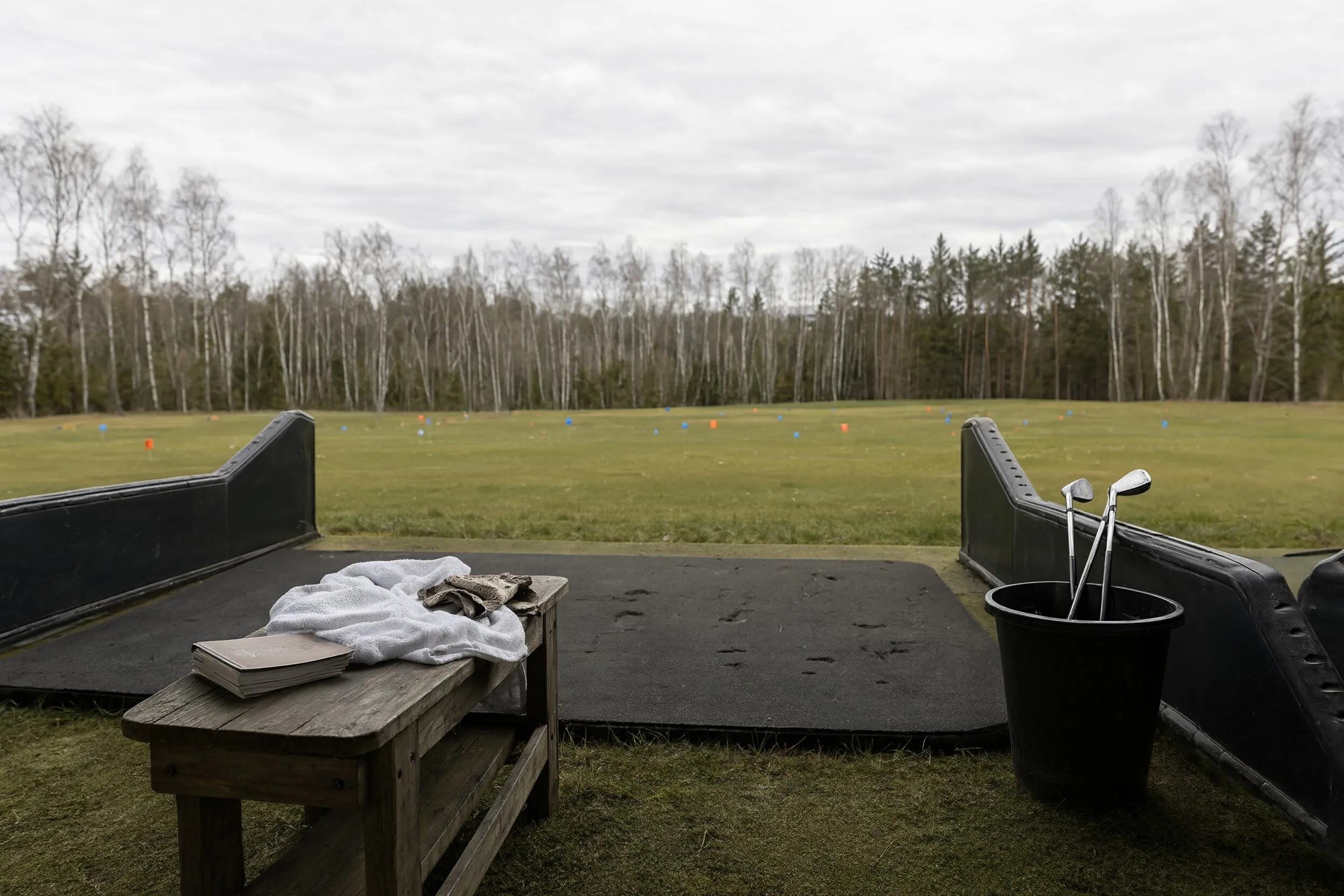
Walk up to any driving range and you will see the same scene playing out: a golfer rips through a large bucket of balls with the driver, then the 7 iron, then back to the driver, with no plan, no targets and no way to tell whether anything improved. An hour of practice like that feels productive but changes almost nothing. A structured 60-minute session, by contrast, can move a specific part of your game forward every single week. The difference is not talent or time — it is architecture. This plan gives you that architecture, minute by minute, and shows you how to adapt it whether you are chasing straighter irons, a longer drive or a calmer short game.
Hitting balls without a purpose trains your brain to treat golf as a repetitive motion rather than a series of decisions. You get good at the thing you practise, and if what you practise is “hit another ball at nothing in particular,” that is exactly the skill you build. Golfers who plateau almost always share this pattern: plenty of range time, very little deliberate work, and no feedback loop that tells them whether today’s session made them better.
Deliberate practice flips that equation. Each session has one focus, one measurable outcome and a clear finish line. You are not trying to hit every shot well; you are trying to rehearse something specific under conditions that resemble the course. A structured hour delivers more improvement than three unstructured ones, and it leaves you with information you can carry into the next session instead of starting from zero every time.
Before you hit a single ball, choose the focus of the session — and keep it to one. Splitting an hour between swing changes, distance control, shaping shots and bunker play means none of them gets enough repetitions to stick. One focus, properly worked, becomes a gain you keep; four foci become a memory of a pleasant afternoon.
Good session focuses worth rotating through your weeks:
Whichever focus you pick, write it on a card or in your phone before you leave the house. On the range, when boredom whispers that you should hit a few drivers “just to see,” the card reminds you what today is actually for.
The first ten minutes are not about grooving technique; they are about waking the body up and finding your rhythm. Start with eight to ten wedges at half speed, feeling the club swing freely and the contact being soft and clean. Then work backward through the bag — 9 iron, 7 iron, hybrid, driver — taking only two or three balls per club. You are not practising yet; you are rehearsing the swing’s tempo and letting your muscles find the day’s gear.
Resist the urge to diagnose anything during the warm-up. Early strikes feel clumsy for everyone, and reacting to them by “fixing” your swing in minute four is how practice sessions derail before they begin. Treat the first ten minutes as a runway, not a test.
This is where the real work happens. With your body warm and your focus chosen, spend twenty minutes on the specific skill of the day, using drills rather than full-speed ball striking. Drills slow you down, and slowness is where learning lives. A session built around, say, start-line control might look like this: ten balls with the gate drill, ten with an alignment stick laid to a target, then twenty balls alternating between the two at half speed — checking after each small block whether the ball is starting where you intended.
Two habits make this block twice as effective. First, use feedback: alignment sticks, tees, headcovers as gates, or simply the turf marks on the range mat that show where your divots start. Second, break the block into sets of five or ten balls with a deliberate pause between sets. Standing still for thirty seconds between sets lets your brain consolidate what the last set taught you, which is precisely what mindless ball-bashing never allows.
Now the practice turns competitive, and this is the block most golfers skip — wrongly. A skills game transfers your technical work into something closer to golf, because it adds a target, a consequence and a score. Golf on the course is not a repetition sport; it is a one-shot-at-a-time sport, and games are how you rehearse that reality.
A simple game that works with almost any focus:
If the day’s focus is the driver, the same game becomes fairway-hitting: count how many of ten drives would have found a thirty-yard-wide fairway. Whatever the focus, the game converts abstract swings into scored performance, and scored performance is what the course actually asks of you.
The final practice block closes the gap between the range and the round. Choose a hole you know — ideally one that gives you trouble — and play it in your head with real shots. Driver off an imaginary tee, then the approach, then the chip or putt if your range has a short-game area. Change clubs every shot, vary the imagined lie and wind, and go through your full pre-shot routine each time instead of rapid-firing balls.
This block also earns its keep psychologically. Walking between shots, resetting, and treating each ball as a fresh situation trains the exact skill that collapses on the course: shifting from practice mode to performance mode. Golfers who simulate holes during practice regularly report that the first tee no longer feels like a different sport.
Two minutes at the end are the cheapest improvement tool in golf. Before you pack up, write three things down: what the session’s focus was, what worked, and what to work on next time. That note turns isolated sessions into a connected programme, and after a month of it you will be able to see patterns in your game that no single round would ever reveal. A small notebook lives permanently in the bag of every serious improver for a reason.
The plan above adapts to any focus, but seeing the full hour laid out makes it easier to follow on the first few visits. The breakdown below shows each block, its purpose and what to do within it — a template you can reuse weekly with only the focus changing.
| Time | Block | What you do |
|---|---|---|
| 0–10 min | Warm-up | Half-speed wedges, then two or three balls per club up to the driver |
| 10–30 min | Technical block | Drills for the session’s single focus, in sets with pauses |
| 30–45 min | Skills game | Ten scored shots at a real target, record the number |
| 45–58 min | Course simulation | Play an imaginary hole, full routine on every shot |
| 58–60 min | Debrief | Note the focus, what worked and next session’s plan |
The proportions matter more than the minutes themselves. Roughly one-sixth warming up, one-third on technique, a quarter under pressure and the rest on transfer and reflection is a ratio that works at every handicap level. If you only have forty minutes some weeks, cut the technical block rather than the game, because scored shots are what make skills course-proof.
The template flexes depending on where your game currently lives, and forcing a beginner into a tour-style session helps nobody. Match the structure to your stage of development rather than copying someone else’s hour.
Whatever your level, protect the debrief. It costs two minutes and is the only part of the session that makes the next one smarter.
Even a good structure can be undermined by a few familiar habits. Recognising them is half the battle, because they all feel reasonable in the moment.
Each of these is easy to correct once named, and none requires more effort — only slightly different choices.
A single structured session helps; a weekly rhythm transforms. Pick a consistent day and time, keep the notebook going, and rotate your focus so no part of the game goes unattended for more than a few weeks. Within a month you will notice something subtle: the range stops being a place where you hope to find your swing and becomes a place where you know exactly what you are working on. That certainty — more than any tip or new club — is what separates golfers who improve every year from golfers who practise the same year twenty times over.