Tee height is the smallest decision in golf that makes one of the biggest differences. Half an inch up or down changes your launch angle, your spin rate and your strike pattern before the swing even begins. Yet most golfers give it less thought than their glove. They jam the ball into the ground one day, stack it on a mountain the next, and wonder why their driving never settles into a pattern. Getting tee height right is a two-minute skill that pays off on every single tee shot you hit.
The driver is designed to strike the ball on a slightly upward path, and tee height is what makes that path possible. When the ball sits higher, the clubface meets it closer to the equator or even above centre, which launches the ball higher with less spin — a combination that produces longer, more penetrating drives. When the ball sits lower, the clubface strikes below the equator, adding spin and sending the flight lower and shorter.
Height also governs strike location on the face. Modern drivers are built so that hits above the centre of the face produce the best combination of ball speed and launch. Tee the ball too low and you are constantly driving it off the lower half of the face, the exact area that loses distance. Tee it too high and you risk popping the ball up or sweeping underneath it. In other words, tee height is really strike control, and strike control is really distance control.
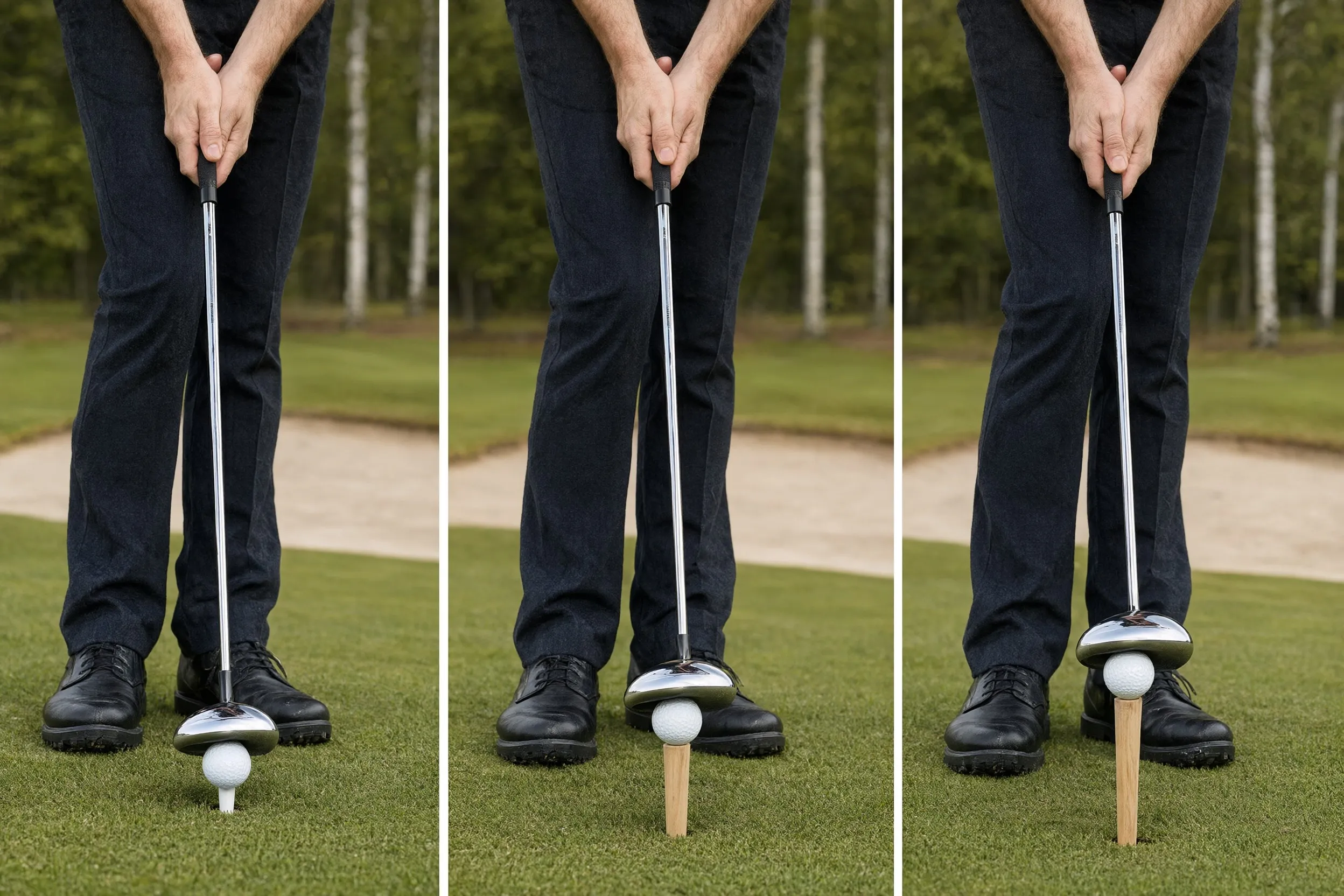
Golfers have used one checkpoint for decades because it works: at address, roughly half of the ball should sit above the crown of the driver. The top edge of the ball aligns with the top line of the clubface, leaving the bottom half hidden behind the clubhead. This position lets the club rise slightly through impact without the face sliding under the ball.
A practical way to verify the rule without guessing:
The rule is deliberately forgiving. It gives you a consistent visual target that works across different driver models and ball types, and it removes the temptation to improvise a new height on every hole. From this baseline, you can fine-tune up or down depending on your swing and conditions.
Teeing up is not just a driver question. Fairway woods, hybrids and even irons on short par threes all have their own ideal heights, and treating every tee shot the same way quietly costs strokes. The reference below lays out the recommended height for each club along with the strike it is designed to produce.
| Club | Recommended tee height | Strike and flight you want |
|---|---|---|
| Driver | Half the ball above the crown; roughly 2 to 3 inches of tee showing | Contact on or slightly above face centre, high launch with low spin |
| Fairway wood | About a quarter to half inch of grass clearance under the ball | Level to slightly descending blow, clean sweep |
| Hybrid | Ball barely above the turf, like a perfect fairway lie | Shallow descending strike, easy launch |
| Iron on a par 3 | Tee pressed fully into the ground, ball on the surface | Identical to a normal fairway strike |
| Wedge on a short hole | Ball on the turf; tee flush with the ground if used at all | Descending, controlled strike with spin |
Notice how the pattern runs from highest to lowest as the club shortens. The driver wants the ball airborne from the first inch of its journey, while everything else in the bag wants the club to meet the ball on or near the ground. A useful habit is to carry a short tee for irons and hybrids on par threes, because pressing a full-length tee into the turf usually leaves it just proud enough to interfere with the strike.
Your ball flight and your driver face are constantly telling you whether your tee height suits your swing. The clues are easy to read once you know what to look for, and correcting the height is often the cheapest fix in golf — no lessons, no new clubs, just a different position at address.
Watch for these signals on the course and the range:
Any one of these signs deserves a range session, not a swing overhaul. Tee the ball at your normal height, hit a dozen drives, then adjust in quarter-inch steps until the strike marks cluster in the centre of the face. That moment of visual proof beats any amount of advice.
The textbook heights assume a fairly standard delivery, but real golfers and real conditions demand small adjustments. If your angle of attack is steeply downward — common among golfers who fight fat iron shots — a slightly higher tee can help the driver launch without excess spin. If you already swing upward dramatically, lowering the tee a fraction keeps the strike centred instead of near the crown.
Wind changes the calculus as well. Into a stiff breeze, teeing the ball slightly lower encourages a lower, more controlled flight that penetrates better. Downwind, a higher tee lets you ride the wind and steal extra carry. Firm, fast fairways reward the low-spinner setup on hot days, while soft, damp turf calls for maximum carry, which usually means the standard or slightly higher position.
Course setup matters too. On tight par fours where accuracy matters more than length, many golfers deliberately tee the driver lower to flatten the flight and narrow the dispersion. On wide-open holes, letting the ball ride high trades a little control for maximum distance. Choosing a height by the shot rather than by habit is a quiet skill that separates thoughtful players from automatic ones.
Finding your ideal tee height takes one focused session, and the payoff lasts for years. You are looking for the height that produces centred strikes and a flight that carries without ballooning. Follow this short sequence at the range:
Within a single range visit you will land within a quarter inch of your ideal, and a few confirming rounds will lock it in. Write nothing down, remember one visual — the half-ball at address — and you have a permanent setting for the most important club in the bag.
Tee height rewards consistency more than brilliance. The half-ball rule gives you a repeatable starting point, the flight and strike marks tell you when to adjust, and the conditions tell you when to bend the rule on purpose. Nail this small detail and every drive starts from a strike you have chosen deliberately rather than one you hope for — and hopeful drives, as every golfer knows, are usually the first ones in the water.