
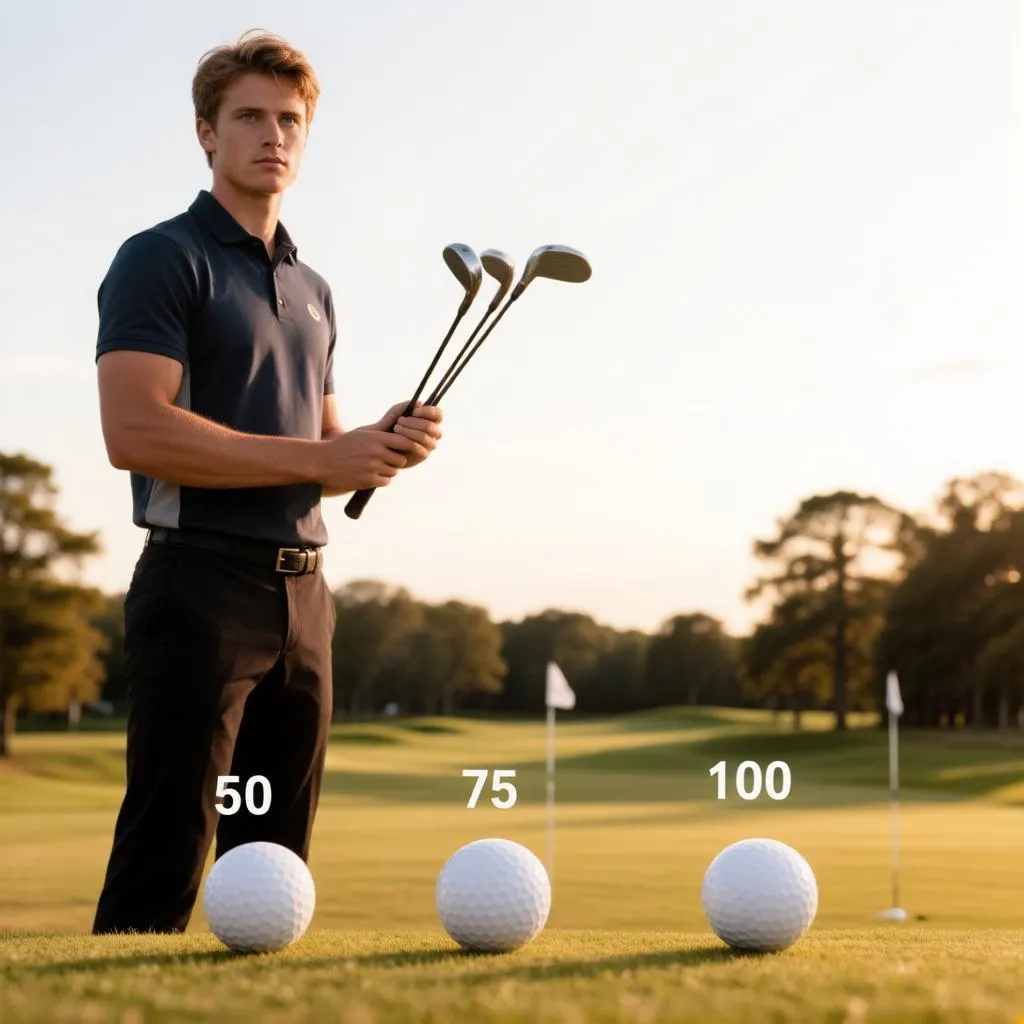
Every golfer knows the feeling: a perfect drive leaves exactly 78 yards to the flag, and suddenly the easiest shot in golf becomes the hardest question on the course. Full swings are known quantities, short chips follow well-worn instincts, but that awkward middle zone — the 50 to 100 yard half-swing purgatory — is where scoring chances quietly evaporate. The statistics of better players tell a blunt story: the gap between a good round and a great one is measured less in driver distance than in how often the wedge shot from inside 100 yards finishes inside fifteen feet of the hole.
The clock method is the oldest and most durable answer to that problem. Its premise is simple to the point of elegance: instead of swinging harder or softer depending on distance, you keep the same tempo always and change only the length of the backswing — measured, like the hands of a clock, at specific positions. Swing to 8 o’clock for short wedge shots, 9 o’clock for mid ones, 10 o’clock for fuller ones, and each position produces a distance that, once calibrated, repeats almost identically every time. What follows is the complete working system: how the method is built, how to calibrate it to your swing, and how the numbers hold together across the three distances that decide most of your scoring.
Amateur wedge play fails for a predictable reason: the short swing’s natural response to distance pressure is to change speed. A shot from 60 yards gets a timid, decelerating motion; the same player then over-fires the next one from 80. Deceleration is the single most destructive habit in wedge play — it kills rhythm, opens the clubface and produces the thin and heavy misses that make the scorecard bleed. The clock method attacks that habit at its root by removing speed from the equation entirely: the swing is always the same speed, always the same tempo, always the same finish. The only variable is geometry — how far the arms travel back.
This is why the method scales with skill rather than against it. Beginners gain because three repeatable positions are easier to own than one fluid, variable-length swing. Better players gain because calibrated stock shots free the mind to work on the elements that actually need feel — wind, lie, green firmness — while the distance decision has already been made mechanically. Feel, in the end, is not the opposite of system; the best feel in golf is built on a system so ingrained that the exceptions can be played against a known baseline rather than guessed in isolation.
The method’s vocabulary is small, and mastering it takes an afternoon. The three core clock positions map to the distances that cover most inside-100-yard shots, with the hands’ position on an imaginary clock face defining the backswing’s length:
Each position carries a matching follow-through principle: the through-swing should mirror the backswing’s length and finish at the corresponding clock position on the other side. The mirror keeps the tempo honest — a short back with a long finish is a deceleration in disguise, and the mirrored finish is the method’s built-in lie detector.
The method becomes real only when the positions meet actual yardages, and that meeting happens in a single, well-structured practice session. The calibration process follows a strict sequence:
A typical set of calibrated numbers for a mid-handicap player looks something like the comparison below, and the pattern matters more than the exact figures: the distances fan out across clubs in a ladder that, once mapped, covers the entire inside-100 zone with no guesswork left in it.
| Clock position | Sand wedge (56°) | Gap wedge (52°) | Pitching wedge (46°) | Typical usage |
|---|---|---|---|---|
| 8 o’clock | 50 yards | 60 yards | 70 yards | Delicate carries, firm greens, tight lies |
| 9 o’clock | 60 yards | 75 yards | 85 yards | The scoring zone’s workhorse; most frequent wedge distance |
| 10 o’clock | 70 yards | 90 yards | 105 yards | Longer carries, wind resistance needed, fuller flight |
The ladder’s real power shows in coverage. With two wedges calibrated at three positions each, a player holds six stock yardages spaced roughly ten to fifteen yards apart — and every distance between them falls within a half-club of a known stock shot. The 75-yard shot that torments most amateurs becomes, in this system, simply “9 o’clock with the gap wedge” — a rehearsed motion rather than an improvised one.
Distance control collapses without tempo, and the clock method’s tempo is worth stating explicitly because it is the system’s spine. The classic rhythm is a three-count backswing and a one-count through — “one-two-three” going back, “one” coming down. The ratio matters more than the absolute speed: a slow backswing with a rushed strike is the classic amateur wedge disaster, and the counted rhythm prevents exactly that. Swing speed stays constant across all three positions; only the arm length changes. Players who count out loud on the range during calibration internalize the ratio faster than players who trust feel — and the internalized count becomes the on-course anchor when pressure tries to speed the hands up.
The follow-through mirror, mentioned earlier, pairs with the count: if the backswing reached 9 o’clock, the finish should reach roughly 3 o’clock on the other side. The mirrored motion forces the club to keep accelerating through the ball and gives the swing a defined end — which is also what makes the method checkable. A wedge swing with no defined finish has no defined distance; the method’s defined positions are precisely what converts a motion into a measurement.
Calibration is the beginning; retention is the ongoing work. The drills that keep the system sharp are short, specific and repeatable, and they fit inside any practice session:
The coin drill deserves priority for players whose calibrated numbers drift. Carry distance variation almost always traces back to low-point variation — the club bottoming out at different depths — and the brushing drill attacks that root directly. Numbers that wander usually have a stable tempo but an unstable strike; fixing the strike fixes the numbers without touching the system.
The calibrated numbers are a baseline, and the course adds conditions the range never simulates. Deviations follow rules rather than feelings, and the adjustment framework keeps the stock shots useful in real conditions:
The fourth rule is the system’s honest boundary. The clock method governs clean lies and standard conditions; it does not replace shot-making, it organizes it. Knowing exactly where your stock shots end makes the exceptions clearer too — the player who knows their 9 o’clock gap wedge is a 75-yard shot also knows precisely how much that shot must change when the lie is perfect but the wind turns against them.
The method’s value shows up where rounds are actually decided. From 50 to 100 yards, the difference between a shot that finishes fifteen feet from the hole and one that finishes forty feet is, statistically, more than half a stroke per attempt — and a mid-handicap golfer typically faces four to six such shots per round. Dialing the wedge zone converts scattered chances into a handful of makable putts, and the compounding across eighteen holes is the difference between the score you have and the score you want.
That arithmetic is also why the system deserves maintenance rather than mastery. Twenty minutes of ladder work once a week keeps the positions owned; a monthly calibration keeps the numbers true; and the on-course decisions stay simple because the baseline never wobbles. The clock method’s promise is modest and permanent: three positions, one tempo, six to nine known yardages — and with them, the half of the scoring game that starts where the full swing ends.