
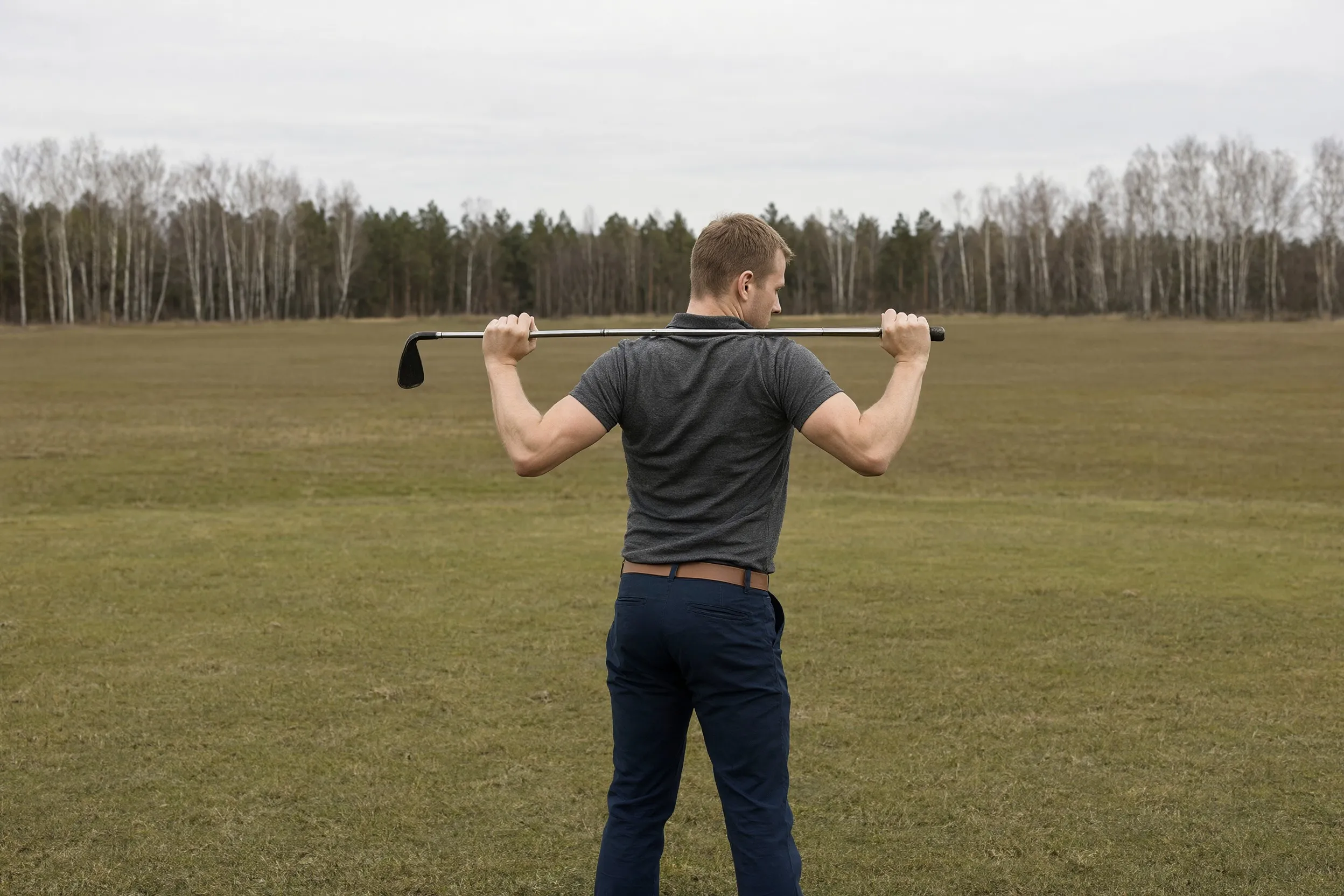
If your backswing feels short, cramped or forced, the problem may not be your technique at all — it may be your shoulders. The golf swing demands more shoulder rotation than almost any everyday activity, and when the joint cannot move freely, the body finds sneaky ways to compensate: the arms lift instead of turn, the lower back twists to borrow range of motion, and the swing loses both width and consistency. Shoulder mobility is one of the most under-rated physical foundations of good golf, and the exercises in this guide require nothing more than a few minutes a day and equipment you already own.
The backswing is fundamentally a rotation, and the shoulders are its engine. A full turn requires the lead shoulder to rotate under the chin while the trail arm folds and the trail shoulder rotates behind the neck — a combined movement that asks each shoulder for a wide arc of motion in several directions at once. When that arc is restricted, the brain refuses to force it and quietly shortens the turn instead. The result is the classic “armsy” backswing: hands high, chest barely rotated, and a downswing that has to recover all the lost sequencing in half a second.
Restricted shoulders also pay a tax on the downswing. A turn that stopped short has to uncoil faster and more violently to reach impact with any speed, which stresses the lower back and shoulders themselves. Golfers who complain of back pain after rounds are often suffering from a shoulder problem that migrated downward. Opening up the shoulders is therefore both a performance project and an injury-prevention project at the same time.
Before exercising, it helps to know what you are training. Shoulder mobility for golf is not about being able to contort in every direction; it is about four specific movements, and the backswing uses all of them together.
If one of these movements is stiff, the swing finds a workaround, and the workaround is almost always worse than the original limitation. The exercises below are organised so that each one targets a specific movement, which lets you diagnose and train rather than simply stretch at random.
Two simple tests reveal whether the shoulders are limiting your turn, and both take less than a minute. Stand with your back against a wall, feet a few inches away, and raise your arms overhead — if your lower back arches or your arms cannot reach the wall without bending the elbows, overhead mobility is restricted. For rotation, sit upright in a chair with your knees together and arms crossed over your chest; rotate to the right and then the left and notice how far you can turn without your knees separating. A difference between the two sides is completely normal, but a large difference usually explains why the ball flies one direction more than another.
Run these tests monthly. They give you a before-and-after measurement for the exercise programme, and progress you can see is progress you will keep doing.
The routine below takes ten to fifteen minutes and needs no gym. A wall, a doorway and a light resistance band cover everything, and a golf club doubles as a mobility tool. Move slowly through each exercise, breathing steadily, and never stretch into sharp pain — mild tension is the goal, discomfort is the signal to back off.
Work through this sequence in order:
Consistency beats intensity here. Three or four sessions per week of ten minutes will change your turn noticeably within four to six weeks, and daily two-minute versions of two or three favourite exercises keep the gains from eroding between longer sessions.
Each exercise exists because it feeds a specific moment in the swing, and knowing the connection makes the routine easier to stick with. The overview below pairs each swing requirement with the mobility work that supports it, so you can prioritise if time is short.
| Swing need | Physical requirement | Best exercises |
|---|---|---|
| Full top-of-backswing turn | Trail shoulder external rotation | Band rotations, open books |
| Lead shoulder under the chin | Lead shoulder internal rotation | Sleeper stretch, club pass-throughs |
| Wide, high finish | Overhead and cross-body reach | Wall slides, pec stretch |
| Connected rotation | Thoracic mobility with the shoulders | Open books, seated rotations |
| Stable, pain-free tempo | Balanced strength through range | Band rotations, wall slides |
The final row is easy to overlook but matters most in the long run. Mobility without strength produces loose, sloppy ranges of motion; adding light resistance work keeps the new range controlled and usable under the speed of a real swing.
When you do the routine matters almost as much as doing it. Before a round or a practice session, run a shortened five-minute version — club pass-throughs, wall slides and a quick pec stretch — to raise temperature and range without fatiguing anything. The full deep-stretching version works best after golf or on rest days, because long static holds temporarily reduce the muscles’ ability to produce force, which is the last thing you want right before hitting balls.
In the evening, the sleeper stretch and open books pair nicely with any wind-down routine, since they require only a floor and a quiet room. A golfer who commits to ten minutes after dinner most days of the week will out-improve one who does an hour-long session once a fortnight — mobility adapts to frequency, not heroics.
A few habits can undermine an otherwise good programme, and spotting them early keeps the work productive.
Each correction costs nothing but attention, and together they turn a casual stretching habit into a programme your swing can actually build on.
Shoulder mobility will not fix a poor grip or a bad sequence on its own, but it removes a ceiling that many golfers never knew was there. Test yourself, work the routine consistently, and watch the two numbers that matter most: how far you rotate in the seated test and where your self-tests land after a month. As those numbers climb, the backswing stops feeling like something you force and starts feeling like something that happens — and that feeling is the quiet reward of every well-trained shoulder in golf.