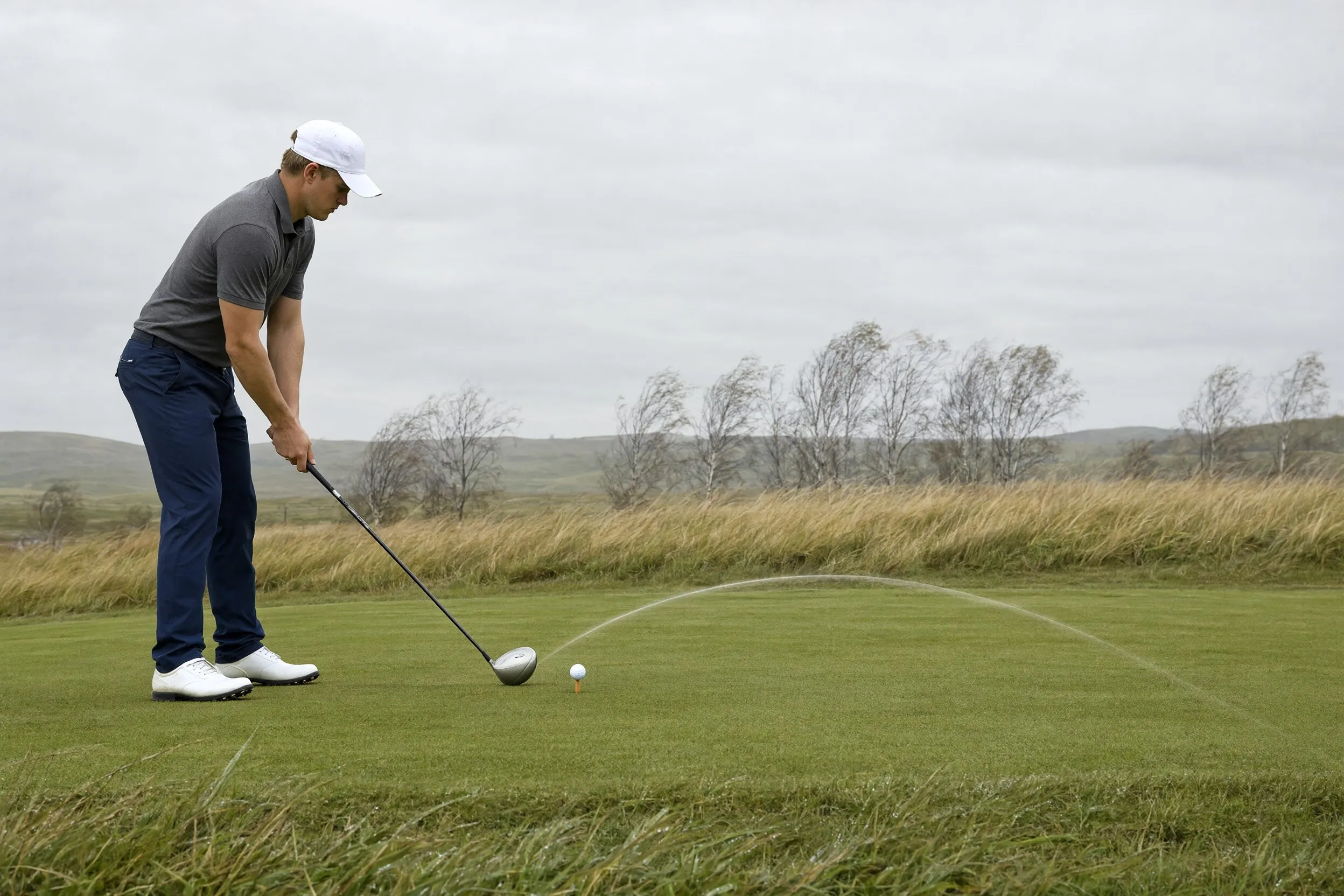
Nothing changes a round faster than a stiff headwind off the tee. Drives that normally find the middle of the fairway suddenly fall out of the sky, curve more than usual and land thirty yards short of where you expected. The wind did not get stronger mid-round — your ball flight got harder for it to carry. The secret to driving well into the wind is not swinging harder, which almost every golfer tries first, but launching the ball with less spin. Once you understand that relationship, headwinds stop being a punishment and become a shot you can plan around.
A headwind acts on two things: the height of your flight and the amount of spin on the ball. Height is obvious — the wind pushes against the climb and shortens the carry. Spin is the hidden killer. Backspin makes the ball climb and stall, so in a headwind every extra revolution lifts your ball higher and drops it shorter. This is why a high, spinny drive that flies beautifully on a calm day collapses in the breeze.
There is a second effect that surprises people: wind amplifies curvature. Any side spin your drive carries becomes exaggerated in a crosswind, so a slight fade becomes a genuine slice once the wind starts pushing on it. Driving into a left-to-right breeze with a natural fade means aiming further left than the calm-day instinct suggests.
Understanding these two effects sets up every adjustment that follows. The goal of a wind drive is a lower launch, reduced spin and a delivery that arrives at the green or fairway still rolling — a shot sometimes described as a “boring” flight, because it stays down and bores through the air.
Your setup is where a wind shot begins, because setup controls the geometry that produces launch and spin. The instinctive reaction — teeing it lower and leaning back — fixes half the problem and creates the other half. Getting the adjustments in the right combination matters more than any single change.
Build the wind setup around these checkpoints:
Notice what is missing: nothing here asks you to swing softer. Deliberately easing off feels safe but raises spin, which is the one thing the wind punishes most. A controlled full swing with reduced spin travels further into a breeze than a gentle punch that balloons.
The physical feel of a good wind drive is a wide, full swing with controlled hands. Adding spin usually comes from aggressive hand action — flipping the wrists through impact or over-releasing them on the way down. In a headwind, keep the wrists quieter, feel the clubhead staying wide through the hitting area, and let the body rotation carry the club to a balanced finish.
A helpful thought is to swing to a finish position you can hold. If your follow-through ends with your weight on the lead side, chest facing the target and the club balanced behind your head, you have delivered the club with the full body rather than with a hand-flip. That finishing position is both the cause and the evidence of a low-spin strike.
Another subtle feel is to keep the face square through impact for slightly longer. A glancing, side-spin delivery magnifies in crosswinds, so encouraging a square face at separation limits how much the ball can curve. You are not trying to force a draw or a fade; you are simply refusing to add curvature the wind will exaggerate.
Choosing how to play the drive matters as much as executing it. Wind is rarely uniform, and reading it properly on the tee gives you the information your setup decisions depend on. Golfers who skip this step tee it high and swing hard regardless, which works until the first exposed hole of the round.
Here is a practical way to gather the facts before you commit:
Once you know the true wind, you can pick a realistic target. Into a strong headwind, the smart play is usually the centre of the fairway with a club you can trust on the next shot, rather than chasing maximum distance into conditions that will steal it anyway.
Every wind drive is a small negotiation between the conditions and your setup. The reference below gathers the most common wind situations with the adjustments that produce the best flight. It is worth reading before the round rather than during it, because these decisions work best when they are calm ones.
| Condition | Setup adjustment | Flight you should expect |
|---|---|---|
| Steady headwind | Low tee, ball slightly back, centred weight | Lower launch, reduced spin, extra roll |
| Strong gusting headwind | Same as steady wind, plus grip down an inch | Controlled flight that resists ballooning |
| Quartering headwind (into and across) | Wind setup plus a line adjusted into the breeze | Flat flight with curvature held to a minimum |
| Crosswind, no head component | Normal tee height, aim into the wind deliberately | Normal flight pushed by the crosswind |
| Downwind | Higher tee, ball forward, full swing | High flight carried and rolled by the breeze |
The table rewards flexibility. The same golfer on the same course may use three different setups across four tee shots, because the wind asks a different question at each hole. Treating the driver setup as a fixed object is what turns ordinary breezes into scoring disasters.
Even golfers who understand the theory undo it with a handful of habits that feel natural but sabotage the shot. Recognising these in your own game is often the difference between a successful wind round and a frustrating one.
If one of these is your regular habit, spend a range session feeling the opposite. The corrections are small, and their effect on your scorecard is anything but.
Golfers who drive well in the wind share a quiet confidence: they know their ball will behave. That confidence is built, not inherited, and it comes from practising the exact adjustments above. A simple range drill is to hit blocks of six drives with your normal setup and six with the wind setup, comparing carry and roll on the same day. The difference teaches the lesson faster than any explanation, and it builds trust in the lower flight before you ever need it on the course.
Take the next breezy round as an opportunity rather than an obstacle. Tee it low, keep your weight centred, swing with committed width and watch the ball pierce the air instead of climbing into trouble. Wind golf rewards the player who adapts, and adaptation here is only a setup change away.