
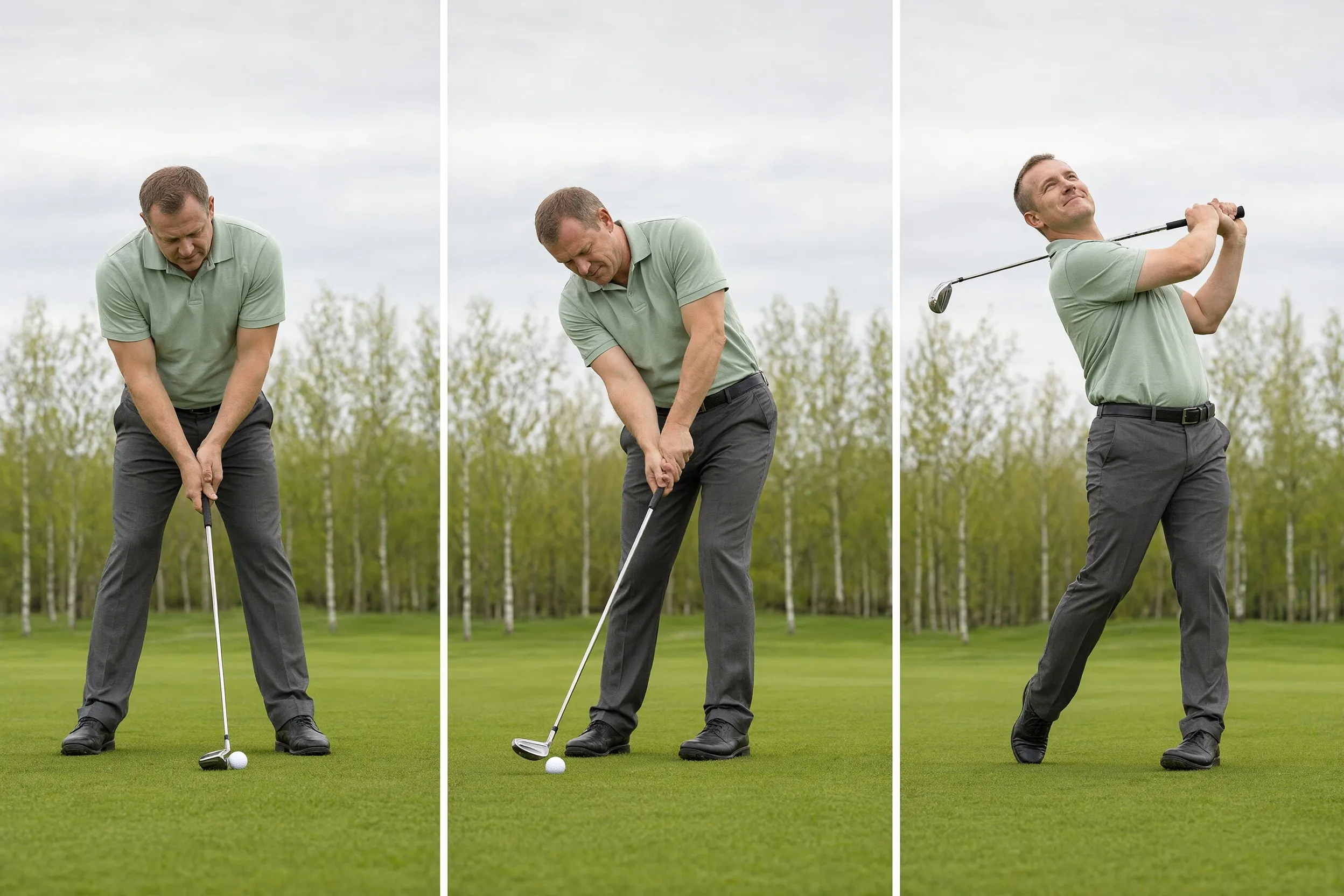
Ask any golfer what would improve their score fastest, and the answer is almost always better iron play. Irons decide how many opportunities you give yourself at birdie, how often you escape trouble cleanly and how confident you feel standing over the ball. The frustrating part is that consistent iron striking does not come from a perfect swing; it comes from a handful of fundamentals done reliably every time. Master the setup, the strike and a simple sequence, and your irons stop being a lottery.
Consistency is not the same as perfection. A consistent iron player hits the ball first, takes a divot after it and sends the ball reasonably close to their intended target most of the time. Notice what is missing from that description: there is no mention of shape, height or hero shots. Touring professionals miss the centre of the face constantly, yet they still find greens because their low point is stable and their face is square at impact.
That is the target worth aiming for. Instead of chasing flawless technique, focus on making your worst strikes better. A swing that produces a mishit fifteen yards offline is far more useful than a beautiful swing that sometimes sends the ball forty yards offline.
Great ball striking begins before the club ever moves. The setup is the one part of the swing you can get exactly right every single time, which makes it the most reliable lever you have. When your grip, posture and alignment stay constant, your body does not have to make mid-swing corrections, and your contact immediately tightens.
Build your iron setup around these checkpoints:
None of these checkpoints are complicated, and that is exactly the point. Because the setup is slow and static, you can verify it in ten seconds before every practice ball. Golfers who skip this step are asking their swing to fix problems their setup created in the first place.
The single most important contact thought in iron play is simple: the lowest point of your swing must happen after the ball. When the club is descending through impact, it pinches the ball against the turf, launches it with controlled spin and produces that satisfying sound of a well-struck iron. When the club is ascending, the result is a thin, weak shot or a heavy dig.
You can read your strike quality directly from the ground. A divot that starts at or just in front of the ball tells you the low point was where it belongs. A divot starting an inch behind the ball means the club bottomed out early — the classic recipe for fat shots. No divot at all with weak ball flight usually means the low point arrived too late and you caught the ball on the upswing.
Two feelings help golfers move the low point forward. First, keep pressure moving toward your lead foot through the downswing, so your body’s centre travels with the club. Second, let your hands lead the clubhead into impact rather than flipping them past. Both create the descending blow that separates solid iron play from hopeful scooping.
Consistency lives in the transition, not in the top of the backswing. Many golfers have a decent backswing and an erratic downswing because they attack the ball from the top with their hands. The reliable pattern is a deliberate transfer of weight toward the target that starts before the arms finish changing direction, followed by the body pulling the club through.
For practice, this drill progression builds the sequence one layer at a time:
Five balls per step is enough. The goal is not exhaustion but imprinting a pattern, so keep the sessions short and frequent rather than long and rare.
Before adjusting anything, you need to know what your misses are actually telling you. Poor iron play usually clusters into a small number of patterns, and each has a distinct cause and a distinct fix. Guessing at solutions without identifying the pattern wastes practice time and often introduces new problems on top of old ones.
Use this overview to match your most common miss with its usual root cause:
| Symptom | Likely cause | First thing to work on |
|---|---|---|
| Fat shots, divot behind the ball | Weight hanging back on the trail foot | Step toward the target through impact |
| Thin shots, no divot | Ball too far back or rising out of posture | Check ball position and spine angle |
| Shots pulled left or pushed right | Body rotating out ahead of the arms | Slow the transition and let the arms catch up |
| Weak, high slices with irons | Open face from an over-the-top downswing | Feel the club dropping behind you first |
| Inconsistent distance shot to shot | Grip pressure too tight or tempo too fast | Soften the hands and count to three in the swing |
Treat the column on the right as a starting point rather than a prescription. If the fix does not produce change within a dozen practice balls, the cause usually sits in the row above it, because symptoms rarely appear alone.
Certain habits show up in almost every golfer who struggles with irons, and they tend to survive even well-intentioned practice. Knowing them helps you catch yourself before they take root.
If you recognise two or three of these in your own game, resist fixing everything at once. Pick the one that shows up most often in your worst rounds and make it your only project for the next few weeks.
Structure beats volume. Two focused half-hour sessions per week, each with a clear theme, will do more for your irons than an occasional two-hour ball beating. One session belongs to short irons and wedges, where contact precision is built; the other belongs to mid and long irons, where sequence and rhythm are the priority. Finish every session with ten shots at full speed toward a target you would actually face on the course, because the range swing is only valuable if it survives under pressure.
Track one number each session: how many of your final ten shots produced a divot starting in front of the ball. That single statistic reflects everything this article covers — setup, sequence, strike and pressure — in one visible measure. When the number climbs, your scores will follow.
Consistent iron striking is built from unglamorous parts: a setup you repeat, weight that moves forward, hands that lead the club into the ball and a tempo you can sustain. None of it requires unusual athleticism, and all of it responds to deliberate practice. Give the fundamentals a few honest weeks and your irons will go from the most stressful part of your round to the most dependable — and golf becomes a very different game when you step onto every tee knowing your second shot will find the green.