
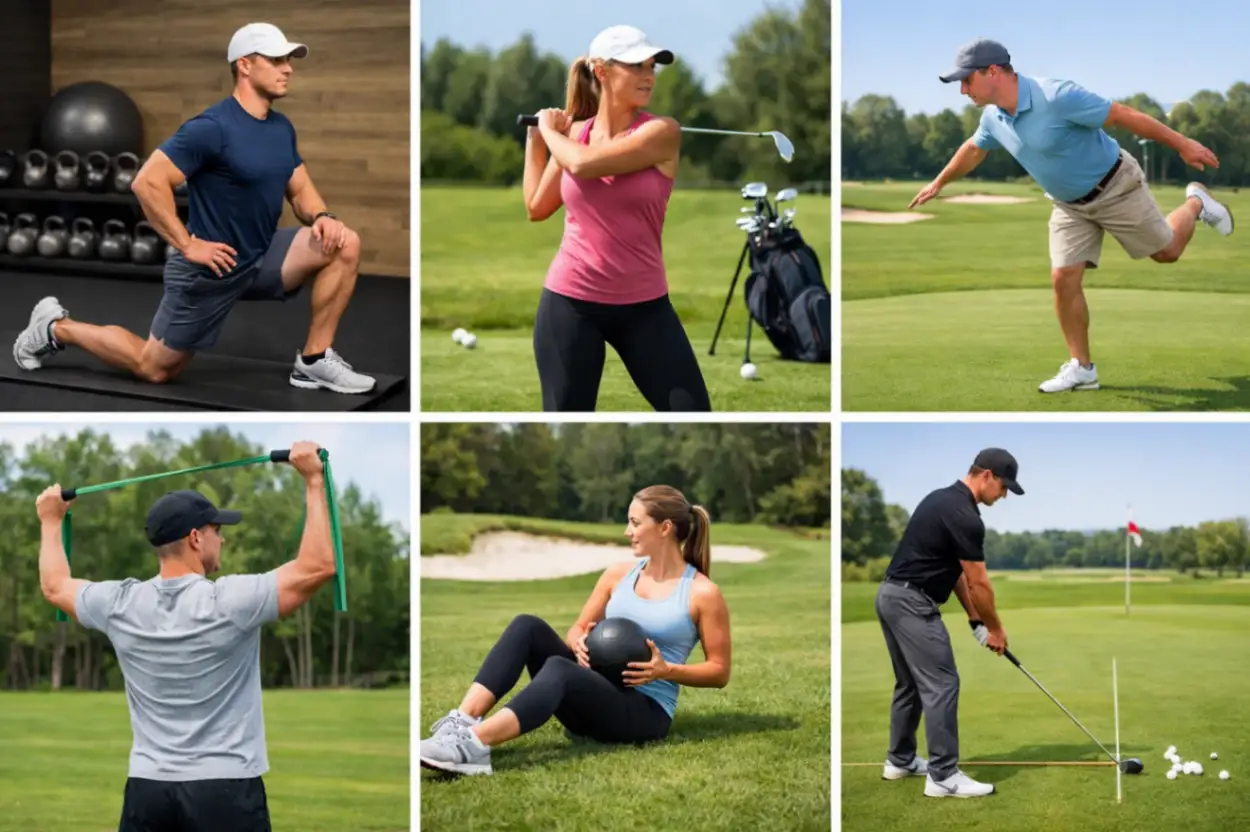
Golf may look like a slow-paced sport, but behind every smooth swing is a combination of mobility, balance, strength, and precise coordination. Beginners often focus on technique alone, forgetting that the body plays an equally important role. Without proper physical preparation, even the best swing advice won’t translate into consistent results on the course.
The right golf exercises can dramatically improve performance from the very first weeks of practice. They help increase swing range, stabilize posture, and build control over every movement. This guide explores the most effective golf exercises for beginners, focusing on mobility, balance, and accuracy — the three pillars of a reliable game.
Golf is a rotational sport that demands flexibility, control, and endurance. A beginner who ignores physical conditioning often struggles with inconsistent swings, lack of distance, and even minor injuries. The body must work as a connected system, where each part supports the next in a fluid chain of motion.
Mobility allows the golfer to complete a full backswing and follow-through without strain. Without sufficient range of motion, swings become restricted, reducing power and accuracy. Tight hips, shoulders, and spine are common limitations among beginners, often leading to compensations that negatively affect technique.
Balance plays a critical role during every phase of the swing. From setup to impact, maintaining stability ensures that energy transfers efficiently from the ground up through the body to the club. Poor balance results in off-center hits and unpredictable ball flight.
Accuracy depends not only on skill but also on body control. When muscles are weak or coordination is lacking, it becomes difficult to repeat the same motion consistently. Exercises that improve stability and control help create a repeatable swing pattern, which is essential for lowering scores.
Physical training also reduces fatigue. Golf rounds can last several hours, and without endurance, concentration and form decline. Beginners who incorporate fitness into their routine often notice improved consistency throughout the entire round, not just the first few holes.
Understanding which muscles are involved in the golf swing helps beginners train more effectively. Instead of random workouts, focusing on relevant areas leads to faster improvement and better results on the course.
Below is a table highlighting the primary muscle groups used in golf and their roles:
| Muscle Group | Function in Golf Swing | Why It Matters for Beginners |
|---|---|---|
| Core (abs & obliques) | Rotation and stabilization | Controls swing power and balance |
| Glutes | Hip rotation and power generation | Drives distance and stability |
| Hamstrings | Lower body support and posture | Prevents loss of balance |
| Shoulders | Swing range and club control | Enables smooth backswing and follow-through |
| Back (lat muscles) | Rotation and posture maintenance | Supports consistent swing mechanics |
| Forearms & wrists | Club control and release | Improves accuracy and ball contact |
Each of these muscle groups works together during the swing. For example, the core initiates rotation, while the hips generate power and the shoulders guide the club. Weakness in any one area can disrupt the entire motion.
Training these muscles doesn’t require heavy weights or complex routines. Bodyweight exercises, resistance bands, and controlled movements are often more effective for beginners. The goal is not to build bulk but to improve coordination and functional strength.
By targeting these areas, beginners can create a strong physical foundation that supports skill development. Over time, this leads to more consistent swings, better control, and increased confidence on the course.
Mobility is one of the most overlooked aspects of golf training, especially among beginners. Limited flexibility restricts movement, making it difficult to achieve proper swing positions. Improving mobility allows the body to move freely, reducing strain and enhancing performance.
To build effective mobility, exercises should focus on key areas such as the hips, thoracic spine, and shoulders. These regions are directly involved in rotation and swing mechanics. A simple routine performed regularly can significantly improve range of motion.
Here are some of the most effective mobility exercises for beginner golfers:
These exercises should be done with control and proper breathing. Rushing through them reduces effectiveness and increases the risk of strain. A short daily routine, even 10–15 minutes, can produce noticeable improvements within weeks.
Improved mobility translates directly into better swing mechanics. Golfers can achieve a fuller backswing, maintain posture throughout the motion, and generate more power without forcing the movement. This not only improves performance but also reduces the risk of injury, which is especially important for beginners adapting to new physical demands.
Balance is a fundamental element of a consistent golf swing. Without it, even technically correct movements can fall apart at impact. Beginners often struggle with weight distribution, shifting too much during the swing or losing stability altogether.
Balance training focuses on strengthening stabilizing muscles and improving body awareness. These exercises teach the body to maintain control in dynamic situations, which is essential during the golf swing.
Simple drills can make a significant difference. Standing on one leg while holding a golf posture helps train stability in the lower body. Adding a slight rotation mimics real swing conditions and improves coordination. Balance boards or soft surfaces can increase difficulty and enhance results.
Core stability plays a major role in balance. Exercises like planks and bird-dogs strengthen the muscles responsible for maintaining posture. When the core is strong, the body remains stable even during powerful swings.
Proper balance allows for better energy transfer. Instead of losing power through unnecessary movement, the golfer can channel it directly into the shot. This results in more accurate and controlled ball flight.
Consistency improves as balance becomes more reliable. Shots become more predictable, and the golfer gains confidence in their ability to repeat the same motion. Over time, this leads to noticeable improvements in overall performance.
Strength is often misunderstood in golf. It’s not about lifting heavy weights but about developing functional power and control. Beginners benefit most from exercises that mimic golf movements and improve coordination between muscle groups.
Lower body strength is crucial for generating power. Squats and lunges help build the muscles responsible for driving the swing. These exercises also improve stability, which directly impacts accuracy.
The core acts as the engine of the swing. Rotational exercises, such as medicine ball twists or resistance band rotations, strengthen the muscles involved in turning the body. A strong core allows for more efficient energy transfer, leading to longer and more controlled shots.
Upper body strength supports club control. Exercises like push-ups and resistance band pulls help stabilize the shoulders and improve swing mechanics. Strong arms and wrists contribute to better control at impact, enhancing accuracy.
It’s important to focus on proper form rather than intensity. Controlled movements ensure that the right muscles are engaged and reduce the risk of injury. Beginners should start with light resistance and gradually increase difficulty as strength improves.
Combining strength with mobility and balance creates a well-rounded training routine. Each element supports the others, resulting in a more efficient and powerful swing. This holistic approach is key to long-term improvement in golf.
Creating a structured routine helps beginners stay consistent and track progress. A balanced program should include mobility, balance, and strength exercises, performed several times per week.
A typical weekly routine might involve short daily mobility sessions combined with strength and balance workouts three times a week. Sessions don’t need to be long — even 20–30 minutes can be effective when done consistently.
Warm-ups are essential before practice or play. Dynamic stretches and light movements prepare the body for activity and reduce the risk of injury. Skipping this step often leads to stiffness and poor performance.
Rest and recovery should not be ignored. Muscles need time to adapt and grow stronger. Overtraining can lead to fatigue and decreased performance, especially for beginners who are still building endurance.
Tracking progress helps maintain motivation. Noticing improvements in flexibility, balance, or swing consistency reinforces the value of training. Over time, these small gains add up to significant performance improvements on the course.
A simple and consistent routine is more effective than an overly complex one. The key is to build habits that support long-term development, making fitness an integral part of the golfing journey.
Golf improvement goes beyond technique. Mobility, balance, and strength form the foundation of a reliable and consistent swing. Beginners who invest time in physical training often progress faster and experience fewer frustrations on the course.
By focusing on targeted exercises, it’s possible to enhance every aspect of the game. Better mobility leads to smoother swings, improved balance ensures stability, and increased strength adds power and control. Together, these elements create a more complete golfer.
Consistency is the most important factor. Regular practice, combined with a structured fitness routine, leads to steady improvement. Over time, the body adapts, movements become more natural, and performance becomes more predictable.
Golf is a long-term journey, and building a strong physical foundation early makes a significant difference. With the right approach, beginners can develop not only better technique but also the physical ability to support it, unlocking their full potential on the course.